Skip to content

00 / Web apps · SaaS · MVP

Web app development & SaaS.

A web app, also called a web application, runs in the browser like a website. On top of that come accounts, roles and data that change every day. We develop SaaS products, MVPs and internal tools, from Duisburg for businesses all over Germany. We run three platforms of our own: Zularis, SnackUp and Bitwise.

Intro call €0Web apps & platforms

01 / What we build

Web apps we develop: six kinds, each one built before.

For each kind, a project where it runs today.

  • 01

    SaaS product

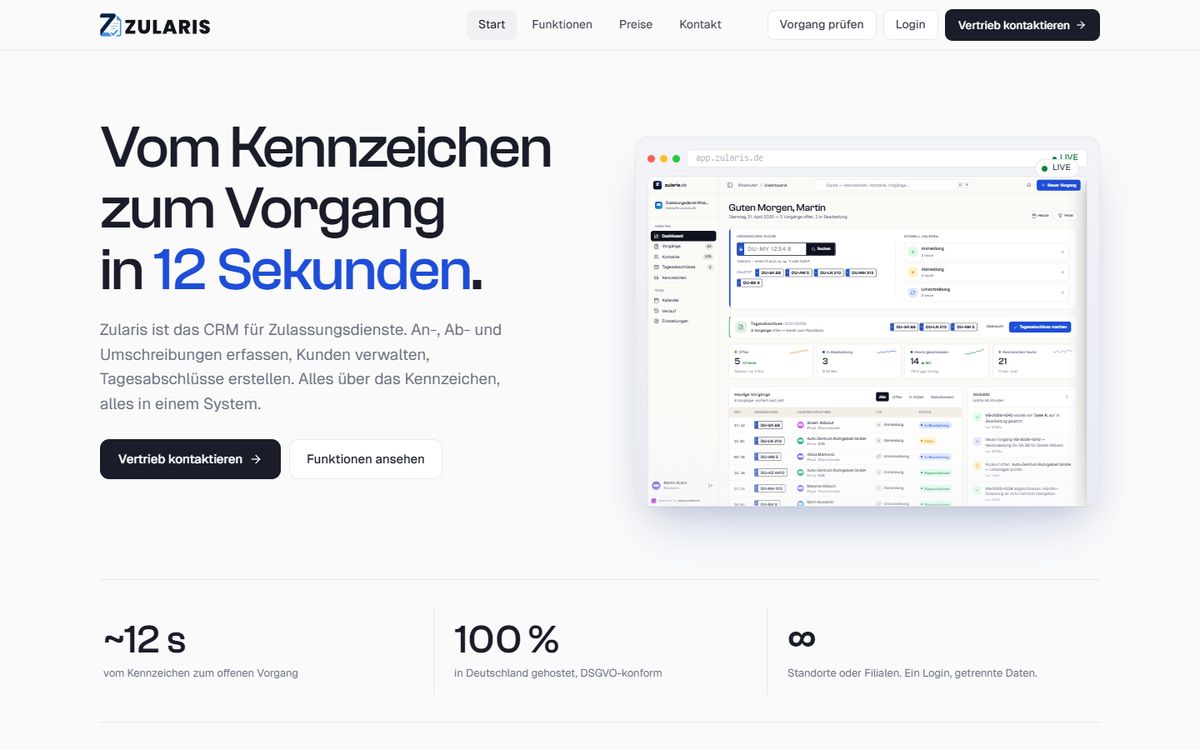
    One piece of software, many customers, each with their own login. Vehicle registration services (Zulassungsdienste) work with Zularis this way, restaurants with SnackUp. We built both and run them ourselves.

    View Zularis ↗
  • 02

    MVP

    The first version of your product idea that real users work with. What they report decides the next sprint. How we do this with our own products is further down.

    MVP and SaaS ↓
  • 03

    Internal tool

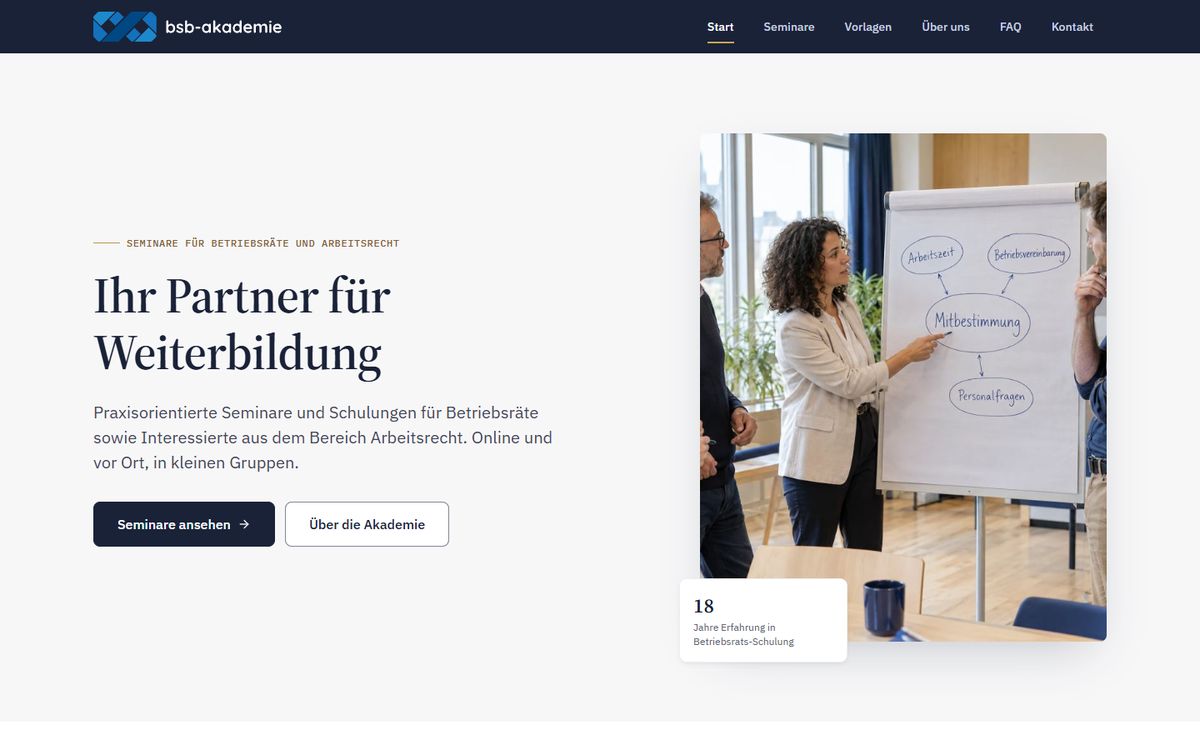
    Software only your team sees. At BSB-Akademie the office enters callers itself, registers groups and sends out the certificates of attendance in one click.

    View BSB-Akademie ↗
  • 04

    Roles and login

    In Zularis, owners and staff have different rights. The registration service’s customer needs no account: with a code and the license plate they see on a status page how far their case has got.

  • 05

    Database and APIs

    If there is an official API, we use it. Zularis sends text messages through Brevo and WhatsApp messages through Meta. SnackUp takes payments through Stripe, PayPal and Klarna.

  • 06

    PDFs and documents

    In the evening Zularis creates the list for the registration office as a PDF, with the seven columns the office needs. Before, someone filled in a nine-column Excel template by hand.

02 / References

What of it runs today.

One client project and four in-house products. We run our own products ourselves, so we also know the time after go-live. Each case study shows what was built and what changed in day-to-day operations.

03 / Structure

How we structure a web app.

Every web app has three layers: the interface, the rules behind it and the data. Around them come the admin area, tests and operations. Which technology goes into which layer depends on who uses the app and who runs it later.

Tools on the web
TypeScript, Vue, Nuxt and React
Tools in the backend
Node.js, NestJS, PHP with Laravel, and C# with .NET
Databases
MySQL and PostgreSQL
InterfaceRulesDataAdminTestsOperations
  • 01

    Interface

    Zularis gets by without a large frontend framework, so it loads fast even on basic office computers. In Bitwise, everyone in the room sees the same question in the same second. That takes React and a live connection over Socket.IO.

  • 02

    Rights

    The first question for the data model is: who may see what? In Zularis each registration service sees only its own cases. Next to the tenant isolation sits a test that checks exactly that.

  • 03

    Data

    Every case, every seminar, every order gets a fixed place, and an audit log records who changed what. The data from your current spreadsheet moves over with it.

  • 04

    Admin area

    What changes often, you maintain yourself. BSB-Akademie maintains seminars, dates and registrations in its own admin, with an illustrated guide right in the system.

  • 05

    Tests

    The seminar management at BSB-Akademie comes with more than 1,600 automated tests and click-throughs in the browser, at desktop and phone size. At Bitwise, every change went live only after the tests had passed.

  • 06

    Operations

    Every app we run is hooked up to monitoring with an alert that comes straight to us. Backups run daily, and before sign-off we restore one once as a test.

    Maintenance and operations →

04 / MVP and SaaS

An MVP built by people with SaaS platforms of their own.

Zularis, SnackUp and Bitwise are our own products. Each started small. What we learned along the way applies to your MVP too.

New versionOne deviceAll devicesA bug shows up before it reaches everyone.
  • 01

    Start with real users

    Bitwise began as a prototype for a single exam, tested by trainees in a training department. In the first week more than 200 users came, without advertising. We worked through what they reported while usage was at its peak.

    View Bitwise ↗
  • 02

    Test with partners

    We first tested SnackUp with two restaurants. The last tests we ran ourselves, with real orders. It has been live since August 13, 2025.

    View SnackUp ↗
  • 03

    One platform for all customers

    All restaurants run on the same system, which recognizes from the address which one is meant. That is why a new restaurant is usually online in two to three days.

  • 04

    Roll out in stages

    New versions of SnackUp go to one device first, then to all. That way a bug shows up before it reaches every restaurant.

05 / Where you fit

Where else you might be in the right place.

Not every project needs accounts and roles, and some industries have their own page.

Accounts needed?noWebsiteyesWorks offline?yesDevice appnoWeb appthis page
  • 01

    A website is enough

    You want to be found and get inquiries, and nobody needs an account. Then a website is the right thing.

    Web design →
  • 02

    It already exists off the shelf

    Whether off-the-shelf software is enough and when your own pays off is covered on the custom software page. It also lists the industries we have built for.

    Custom software →
  • 03

    You run seminars

    For seminar providers and academies, a separate page shows what goes into a seminar management system.

    Seminar management →
  • 04

    You run a registration service

    Then take Zularis first. What we build for registration services beyond that is on its own page.

    Software for registration services →
  • 05

    The work should run by itself

    Sorting emails, reading documents, routing tickets: that belongs to AI automation.

    AI automation →
  • 06

    Without a connection

    If the software has to work without a signal, we build an app for the device. Bremshelfer does the calculation for train drivers on an Android device.

    View Bremshelfer ↗

06 / What it costs

What a web app costs.

We bill by the hour, and how many hours it takes depends on the scope. A platform the size of Zularis costs from €45k. For your project, the calculator on the contact page gives you a cost estimate: four questions, no contact details.

An MVP costs less because it does less. What goes into the first version we set down in the specification, and you see the price in the quote before anything is built. You pay in stages, 25% up front per stage.

Four questions, then you see budget and weeks.

What it’s about, how big, how demanding, how urgent. No obligation and no contact details. If you send an inquiry afterwards, you don’t type anything twice.

Get a cost estimate
System like Zularis
from €45k
Intro call and cost estimate
€0

Every payment comes after a sign-off. You can step out between any two milestones.

07 / How it works

How web app development works: from the data model to production.

We build in one-week sprints. The steps before that settle what the app has to do and what it costs.

  1. 01

    Two days with you

    Before we build, we spend two days with you and watch how the work gets done today. That shows us who needs which data and where it lives now.

  2. 02

    Specification

    Data model, roles, APIs and acceptance criteria go into it. You approve it, and only then do we build.

  3. 03

    Sprints with a demo

    Every week ends with a demo. In between you see the current state on the test system.

  4. 04

    Go-live

    Once the acceptance criteria are met, the app goes live, with domain and hosting.

  5. 05

    Operations

    Monitoring, daily backups, a reply within three hours. Changes of up to one hour of work are included in maintenance.

The full process ↗

08 / Questions

Questions about web app development.

What is a web app?
Software that runs in the browser, on a computer as well as on a phone, with nothing to install. Unlike a website it has accounts, roles and data that change all the time. Zularis is such a web app: the office manages its cases in it, and the customer sees on a status page how far theirs has got.
What is the difference between a website and a web application?
A website shows every visitor the same content. In a web application you log in and see your own data, and that data keeps changing. If nobody needs an account, a website is enough.
How much does it cost to have a web app developed?
That depends on the scope. A platform the size of Zularis costs from €45k, an MVP less. For your project, the calculator on the contact page gives you a cost estimate, in four questions and with no contact details. The intro call and cost estimate cost €0. You see the exact price in the quote before anything is built.
Do you work at a fixed price or bill by effort?
By effort, in hours. The basis is the specification: you see the price in the quote before anything is built. You pay in stages, 25% up front per stage. Every payment comes after a sign-off, and you can step out between any two milestones.
How long does it take to develop a web app?
For platforms, several months is realistic. We started the seminar management for BSB-Akademie in May 2026, it has been online since October, and the work goes on. You see the progress every week in the demo.
Can you build an MVP for my product idea?
Yes. The first version gets the workflow your users come for, with login and data. The rest we build sprint by sprint, based on what the first users report. That is how Bitwise grew.
Web app, PWA or native app?
For most workflows the browser is enough: one address, no app store, every improvement reaches everyone at the same time. A PWA is a web app that can be placed on the home screen and caches parts of itself. We build a native app for the device when it has to work without a connection, like Bremshelfer. SnackUp has both: guests order in the browser, and the kitchen runs its own app with a receipt printer.
Can an internal tool replace our Excel lists?
Yes. In an internal tool every case has a fixed place, and an audit log records who changed what. At Zularis, someone used to fill in a nine-column Excel template by hand in the evening. Today the system creates the list as a PDF. The data from your current spreadsheet moves over too.
Can the web app be connected to our existing systems?
Yes. If there is an official API, we use it. Zularis sends text messages through Brevo and WhatsApp messages through Meta, SnackUp takes payments through Stripe, PayPal and Klarna. Which APIs your web app needs is set down in the specification.
Which technology do you build with, and who owns the code?
That depends on the app and on who runs it later. Zularis runs on Laravel and MySQL, Bitwise on React, Node.js and PostgreSQL, SnackUp on NestJS, Next.js and MySQL. If your business has its own IT team, we follow their stack. In a client project, the source code lives in your repository.
Who sees the data in the web app?
Each user sees what their role allows, and on a platform each customer sees only their own data. We write a test that checks exactly that. Who changed what is recorded in the audit log. If we process your data, we sign a data processing agreement under Art. 28 GDPR.
What happens after go-live?
If we run the web app, it is hooked up to monitoring with an alert that comes straight to us, and it is backed up daily. With a maintenance contract we’re reachable daily from 6 a.m. to 11 p.m. and get back to you within three hours. Changes of up to one hour of work are included. Anything beyond that gets a price before it is built.
Can I have a web app developed if I’m not in Duisburg?
Yes. Our office is in Duisburg, and our clients come from the Ruhr area and from all over Germany. Calls happen by phone, and before we build, we come to your business for two days. After that you see the progress every week in the demo.
Tell us briefly about your project

The intro call costs nothing, and neither does the cost estimate after it. If what you need can be bought off the shelf, we tell you its name and send no invoice.

Start a project

We usually reply the same business day