App / For train drivers
Calculate brake percentage, with the working shown.
Enter your train and see the brake percentage under Ril 915 right away, with every deduction and every rule. Below it you’ll find how the calculation works. For use out on the line there’s Bremshelfer, the free Android app that does the same calculation offline.
 by

Calculator / Right here
Calculate brake percentage now.
Example from section 04 loaded. Enter your train.
- Total weight
- 1,084 t
- Total length
- 639 m
- Braked weight
- 777 t
- Brake position
- Loco G · Consist P
Working
- Consist (P)800 t − 10% = 720 t
- Loco · BR 185 (G)77 t − 25% = 57 t
- Brake percentage777 × 100 ÷ 1,084 = 71.68 → 71
Rules applied
- Consist weight 801-1200t → loco in G, consist in P
- P braked weight: 10% deduction (train length 601-700m)
- Loco braked weight: G used
Out on the line with no signal?
This calculator needs a connection. Bremshelfer does the same calculation offline on your phone, with history, your own classes and a formula reference.
Get Bremshelfer for freeRil 915 and the rules of your railway undertaking are what count. The calculator works like the Bremshelfer app and shows every step, so you can check the result. It does not replace the brake calculation required by the rules.
Video / In one minute
Bremshelfer in one minute.
01 / The formula
Braked weight divided by train weight, times a hundred.
Brake percentage = braked weight × 100 ÷ total weight
The total weight is the weight of the wagon consist plus the weight of all locomotives. The braked weight is the sum of the braked weights of the consist and the locomotives, but only after the deductions for train length and brake type. The result is rounded down to a whole number.
The deductions are what make the calculation error-prone. Which one applies depends on the length of the consist, the brake type and the weight.
02 / Deductions
What gets deducted from the braked weight.
P braked weight
Deduction by length of the consist. Also applies to the locomotive if it runs in P.
| Consist length | Deduction |
|---|---|
| up to 500 m | no deduction |
| 501 to 600 m | 5% |
| 601 to 700 m | 10% |
| over 700 m | 19% |
G braked weight
Deduction depends on whether the consist also has P brakes. Also applies to the locomotive if it runs in G.
| Case | Deduction |
|---|---|
| G brakes only, up to 700 m | no deduction |
| G brakes only, over 700 m | 5% |
| P brakes in the train, up to 700 m | 25% |
| P brakes in the train, over 700 m | 25%, then 5% |
After each deduction the value is rounded down to whole tonnes. If your company sets its own deductions, you enter them in Bremshelfer by hand. They then apply instead of the length-based deductions.
03 / Brake position
Which position the locomotive and the consist get.
| Consist weight | Loco | Consist |
|---|---|---|
| G brakes only in the consist | G | G |
| up to 800 t | P | P |
| 801 to 1,200 t | G | P |
| over 1,200 t | G | mixed |
Mixed position
Over 1,200 t, the first five vehicles of the consist run in G and the rest in P. Their braked weight therefore counts as G, with a 25% deduction.
Braked weight of the locomotive
Up to 800 t of consist, the locomotive’s P braked weight counts. Above that, its G braked weight.
Minimum wagon weight
From 1,601 to 2,500 t, no vehicle may weigh less than 32 t. From 2,501 to 4,000 t, none may weigh less than 40 t. No articulated wagons either. Over 4,000 t, P is not permitted.
04 / Example
A freight train, step by step.
Consist of 1,000 t and 620 m, all wagons with P brakes, 800 t of braked weight in total. In front, a class 185 weighing 84 t with 77 t of G braked weight.
- 1
Brake position
1,000 t falls between 801 and 1,200 t: locomotive in G, consist in P. So the locomotive’s G braked weight applies.
- 2
Consist
620 m falls between 601 and 700 m, so 10% is deducted from the P braked weight.
800 t − 10% = 720 t
- 3
Locomotive
G braked weight with P brakes in the train, up to 700 m: 25% deduction, rounded down.
77 t − 25% = 57.75 t → 57 t
- 4
Totals
Braked weight 720 t + 57 t = 777 t
Total weight 1,000 t + 84 t = 1,084 t
- 5
Brake percentage
777 × 100 ÷ 1,084 = 71.68 → 71
If the timetable requires more than 71, the braked weight is not enough for this line.
05 / The app
Bremshelfer does the math for you, even in a dead zone.
Calculate
Type in the train, pick the class, calculate. Under “Herleitung” (working) you see every deduction.
Multiple locos
Two class 189s hauling 1,600 t: each locomotive gets its own deduction, 70 brake percentage in total.
Formula reference
Brake technology, loads, running time and more, expandable and offline.
Offline
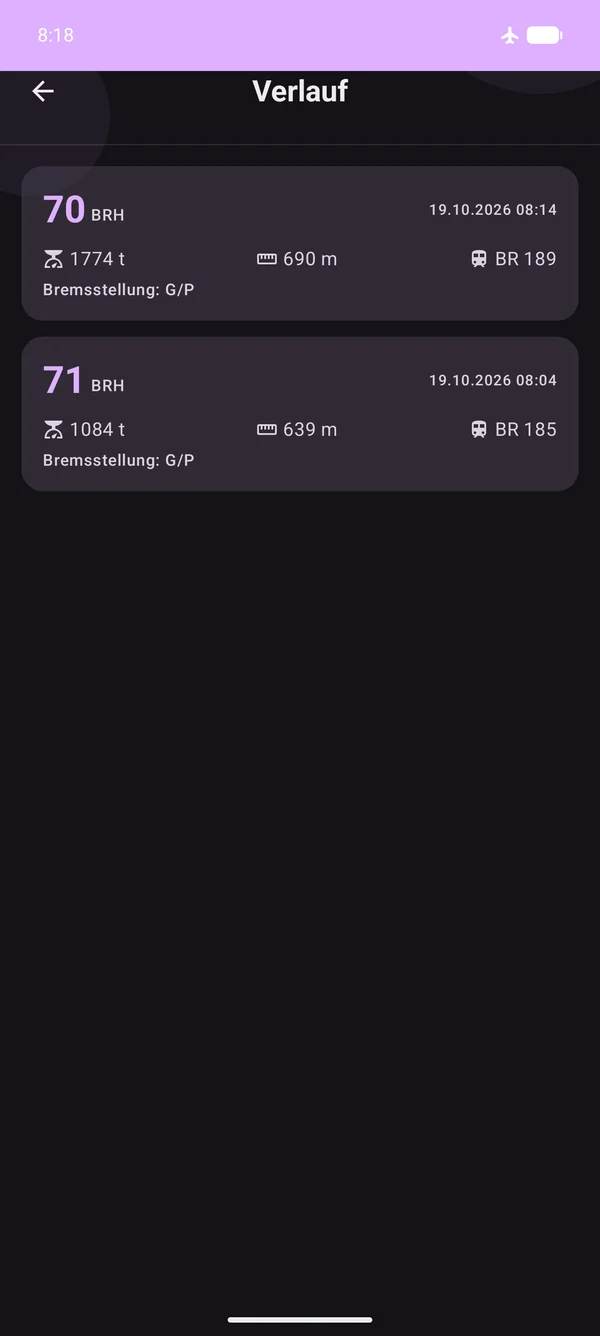
Calculation, classes, history and formula reference are stored on the phone. Every screenshot here was taken in airplane mode.
Checked by a train driver
We built the app with a train driver. During development he checked the results against his own calculations.
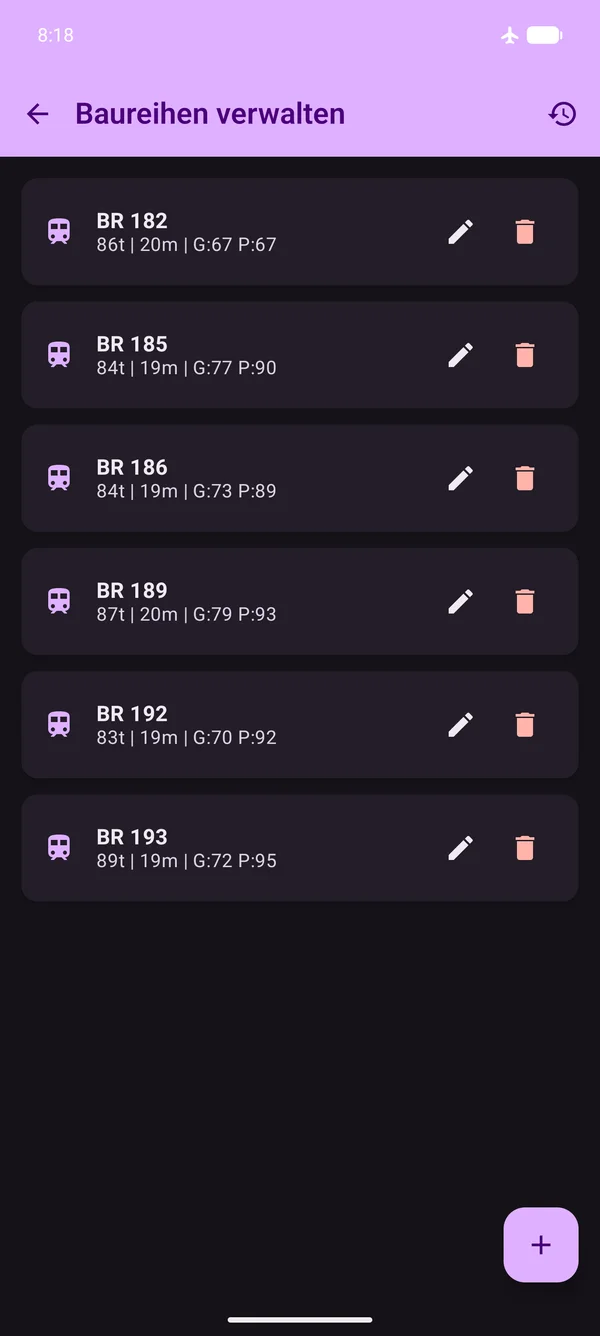
Preloaded classes
You can add more classes in the app yourself. Earlier calculations are kept in the history.
| Class | Weight | Length | Braked weight G | Braked weight P |
|---|---|---|---|---|
| BR 182 | 86 t | 20 m | 67 t | 67 t |
| BR 185 | 84 t | 19 m | 77 t | 90 t |
| BR 186 | 84 t | 19 m | 73 t | 89 t |
| BR 189 | 87 t | 20 m | 79 t | 93 t |
| BR 192 | 83 t | 19 m | 70 t | 92 t |
| BR 193 | 89 t | 19 m | 72 t | 95 t |
Free for Android, funded by ads.
06 / Questions
What train drivers ask about it.
- What is brake percentage?
- Brake percentage (Bremshundertstel) states how much braked weight a train has relative to its weight, as a percentage. A train weighing 1,000 t with 800 t of braked weight has a brake percentage of 80. Before departure, the train has to reach at least the brake percentage the timetable requires for the line.
- Is the result rounded up or down?
- Down. Bremshelfer rounds the braked weights down after each deduction and the brake percentage down to a whole number at the end. That way the result is never higher than what the train actually has.
- Does the locomotive count toward the weight?
- Yes. The weight and braked weight of the locomotive are part of the train. With multiple locomotives, all of them count. For the length-based deductions, Bremshelfer uses the length of the consist.
- Does the app work offline?
- Yes. Calculation, classes, history and formula reference are stored on the phone. The app only needs a connection for updates from Google Play and to send feedback.
- Is Bremshelfer available for iPhone?
- No, so far only for Android. The app is free on Google Play and funded by ads.
- Does the app replace the brake calculation required by the rules?
- No. Ril 915 and the rules of your railway undertaking are what count. Bremshelfer does the calculating for you and shows every step, so you can check the result.
Bremshelfer is an in-house product of Zeasy Software from Duisburg. How the app came about is told in the case study. You can send feedback directly from the app.